


The principle of tool changing in machining centers: precise coordination hidden in the “brain” of the machine
2025-11-26
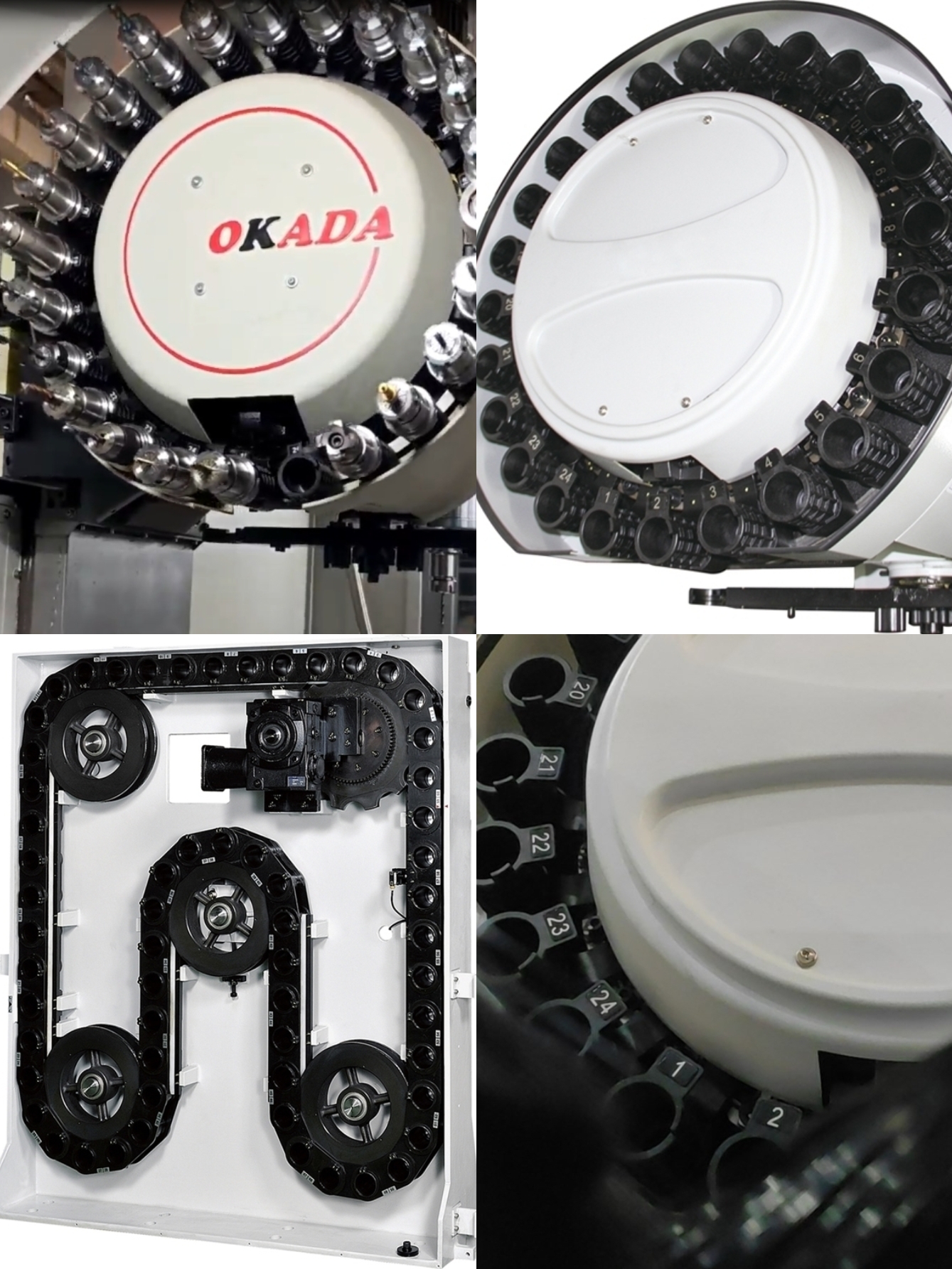
On the “metalworking table” of a machining center, the tool magazine is the most inconspicuous, but the most important “behind the scenes boss”. It controls the storage and retrieval of dozens of tools and determines the speed at which they are changed, directly affecting machining efficiency and even part accuracy. Today we will clearly explain the basic principles of changing a tool magazine and talk about the technological advantages of our company - a manufacturer and exporter of machine tools with 15 years of experience.
This is not just a “tool cabinet”, it is also a “smart planner”.
Machining centers can perform multiple operations in a single setup thanks to a tool magazine, a device similar to an “ammunition magazine.” The tool magazine stores a variety of cutting tools, such as cutters and drills, and its main function is to quickly and accurately feed the desired tool into the spindle in accordance with specified software instructions.
How important is tool change efficiency? For example, in automotive parts manufacturing, a 5-second tool change can increase daily productivity by 20%; For precision parts, tool change errors greater than 5 micrometers (equivalent to 1/20 the diameter of a human hair) can result in the failure of an entire batch of parts. So the essence of a tool shop is that it is an automated system that combines precision and speed.
Tool change: four steps to complete tool change.
Taking the most common disc tool magazine as an example, the process of changing tools is like a precise dance consisting of four steps:
1. Submitting a command: the CNC system issues the command “Change tool!”
When a machining program requires a tool change, the CNC system sends a command to the tool shop: “Please send tool T12!” The tool magazine PLC immediately checks the “Tool Position Chart” to find the required tool.
2. Tool search: The tool head “returns” at high speed.
The tool magazine begins searching for a tool: in rotary tool magazines, a servo motor rotates the tool head and a high-precision encoder rotates the desired tool to the “tool change position” (straight ahead); In chain tool magazines, the chain moves the tool holder, precisely stopping it in position. Speed and stability are critical - positioning error must be less than 3 micrometers, otherwise the tool grip will drift.
3. Tool grip: The robotic arms perform a “handshake” to complete the tool change.
Two robotic arms move synchronously: one robotic arm releases the old tool from the spindle and returns it to the tool magazine; another robotic arm grabs the new tool and pulls it into the spindle to lock it into place. The system checks three aspects: timing (performs within 2-4 seconds), clamping force stability (tool will not break or fall out), and positioning accuracy (tool holder and spindle are perfectly aligned with an error of less than 0.01mm).
4. Confirmation: system check
After a tool change, the tool shop checks to see if the contact sensor is in contact with the groove of the tool holder, or uses a laser measurement to measure the length and diameter of the tool to ensure the tool is present and the correct type. If any problem occurs, the system will sound an alarm and stop working to prevent errors from occurring.
Our tool changing technology is stable, intelligent and convenient.
With 15 years of machine tool export experience, we understand that customers need more than just an "automatic tool changer", they need a "consistently reliable automatic tool changer". Our automatic tool changers therefore offer three main advantages:
Reliable transmission: ball screws and servos eliminate backlash, ensuring positioning accuracy of ±2 microns, low vibration levels and long service life;
Intelligent Tool Changing: Artificial intelligence (AI) learns and optimizes tool paths, adjusting speed based on tool weight for smoother operation;
Protection: Dust brushes and O-rings prevent metal chips from flying around, dual sensors prevent collisions, and an emergency lock prevents collisions—suitable for high-humidity, dusty environments around the world.
The tool changer embodies the manufacturer's dedication to craftsmanship.
From manual tool changing to near level 2 automation, the evolution of tool shops is a microcosm of increased production efficiency. Precise single tool changing is based on the deep integration of mechanical precision, control logic and user needs.
As part of the Chinese machine tool industry's "going global" strategy, we firmly believe that superior equipment speaks for itself: when customers save even a second of cycle time with our tool shops, and international factories significantly reduce downtime thanks to our stability, all technology investments are worth it.
Пожалуйста, оставьте нам сообщение
-


-


-


-


QR code for DRC business consultation on WeChat
